

In 2026, the SaaS landscape has changed dramatically. Buyers expect instant value, self-service experiences, and products that “just work.” That’s why Product-Led Growth (PLG) has become the dominant go-to-market strategy for high-growth SaaS companies.
PLG turns your product into the primary engine for customer acquisition, activation, retention, and expansion — replacing (or dramatically reducing) heavy sales and marketing spend.
This in-depth guide explains everything you need to know: what PLG really is, why it works better than ever in 2026, the exact strategies top companies use, key metrics, real examples, implementation steps, and emerging trends.
What Is Product-Led Growth (PLG)?
Product-Led Growth is a go-to-market strategy where the product itself drives sustainable, scalable growth. Users sign up easily (often via freemium or free trial), experience value quickly, and upgrade or invite others organically.
According to the official definition from ProductLed:
“An end-user focused growth model that relies on the product itself as the primary driver of customer acquisition, conversion, and expansion.”
Unlike traditional Sales-Led Growth (SLG) — where sales teams chase deals — or Marketing-Led Growth (MLG) — where ads and content fill the funnel — PLG lets the product sell, onboard, and expand itself.
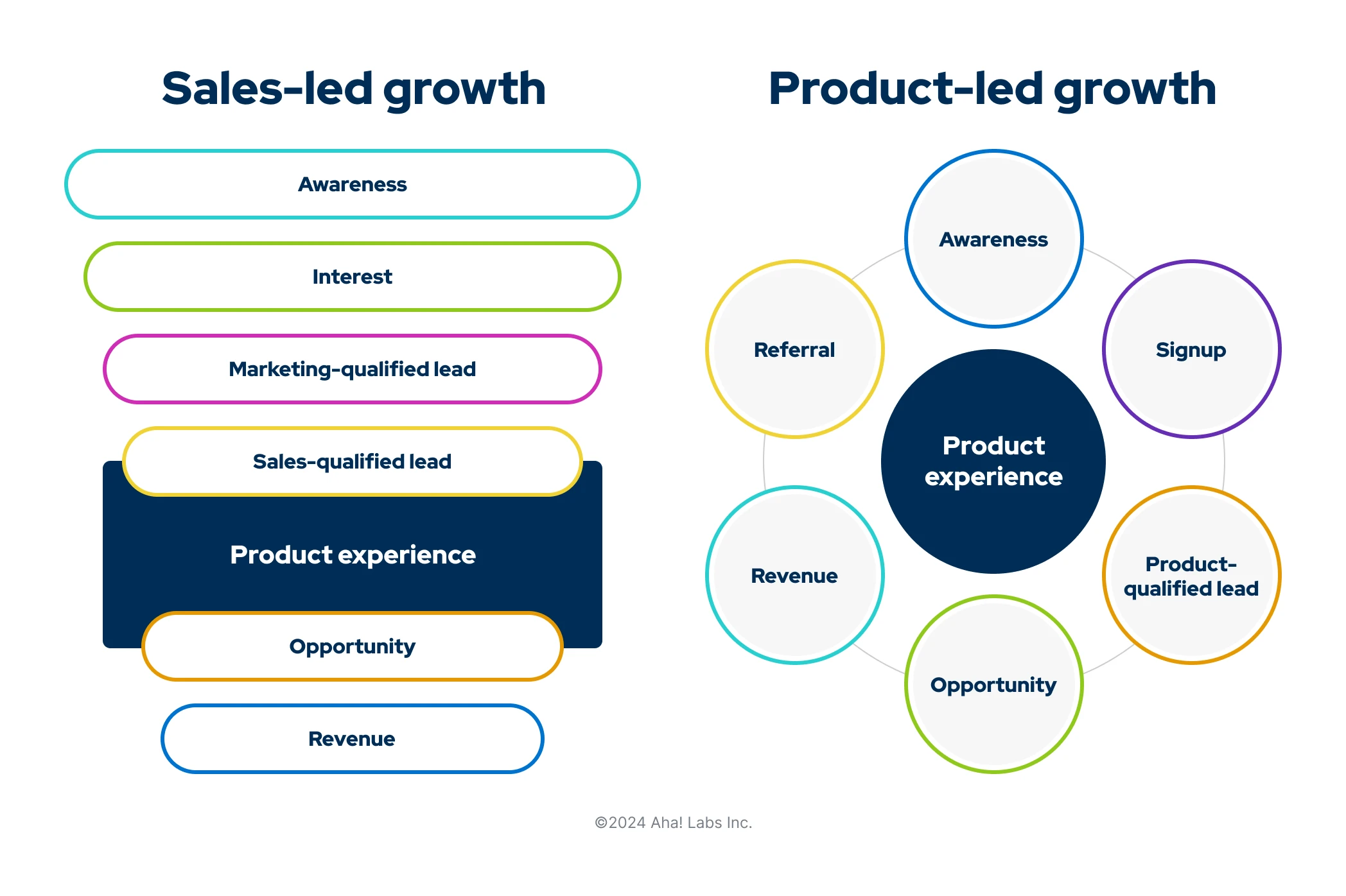
Sales-Led vs. Product-Led Comparison (Visualized)
| Aspect | Sales-Led Growth | Product-Led Growth |
|---|---|---|
| Main Focus | Sales team & relationships | Product experience |
| Sales Cycle | Long (weeks/months) | Short (minutes/hours) |
| Target Audience | Decision-makers & executives | End-users & practitioners |
| Customer Acquisition | Outbound + demos | Self-service + virality |
| Pricing Model | Seat-based contracts | Freemium / usage-based / tiered |
Why PLG Is Exploding in 2026
Recent data confirms PLG’s dominance:
- 91% of SaaS companies with PLG in place plan to invest more in it in 2026 (ProductLed 2025 Benchmarks).
- PLG companies are valued 30%+ higher than the public SaaS index on average.
- 39% of 2025 Series A startups already enable self-serve/PLG motions.
- 58% of all SaaS businesses run a PLG model today.
- AI-native products are accelerating PLG: 27% of all AI application spend flows through PLG motions.
Modern buyers (especially Gen Z and Millennials in the workforce) research independently and hate long sales cycles. They want to try before they buy — exactly what PLG delivers.
The Product-Led Growth Flywheel: How Growth Compounds
The magic of PLG is the self-reinforcing flywheel:

The 5 Stages of the PLG Flywheel:
- Strangers → Evaluate (Discovery via content, SEO, or viral shares)
- Explorers → Activate (Sign up + first “Aha!” moment)
- Beginners → Adopt (Habit formation & regular use)
- Regulars → Expand (Upgrades, seats, premium features)
- Champions → Advocate (Referrals, reviews, word-of-mouth)
Every time a user becomes a Champion, they bring new Strangers — and the wheel spins faster.
Core PLG Strategies & Tactics for SaaS (2026 Edition)
Here are the proven, battle-tested strategies:
1. Frictionless Onboarding & Instant Time-to-Value (TTV)
- Goal: Deliver the “Aha!” moment in under 5 minutes.
- Tactics: Interactive walkthroughs, smart defaults, templates, AI-guided setup, progress checklists.
- 2026 twist: AI agents that personalize onboarding in real time.
2. Freemium or Generous Free Trials
- Let users start for free with meaningful limits (or full access for 14–30 days).
- Best practice: Gate advanced features only after value is proven.
3. Built-in Virality & Network Effects
- Invite teammates → get more storage/credits (Dropbox style).
- Shareable links, collaborative editing (Figma, Notion, Canva).
- Referral programs with clear rewards.
4. Usage-Based & Outcome-Based Pricing
- Shift from seats to “pay for what you use” or “pay for outcomes achieved.”
- This is the #1 predicted pricing trend for 2026.
5. Product-Qualified Leads (PQLs) Instead of MQLs
- Track in-product behavior (e.g., “created 10 projects” or “invited 3 teammates”) to identify hot leads.
- Trigger smart in-app upsells or light sales touches only for high-intent users.
6. In-Product Self-Service & Education
- Tooltips, contextual help, embedded knowledge base, community forums.
- AI chat support inside the product.
7. Continuous Experimentation & Analytics
- A/B test every onboarding step, pricing page, and feature prompt.
- Use tools like Mixpanel, Amplitude, or Pendo for real-time insights.
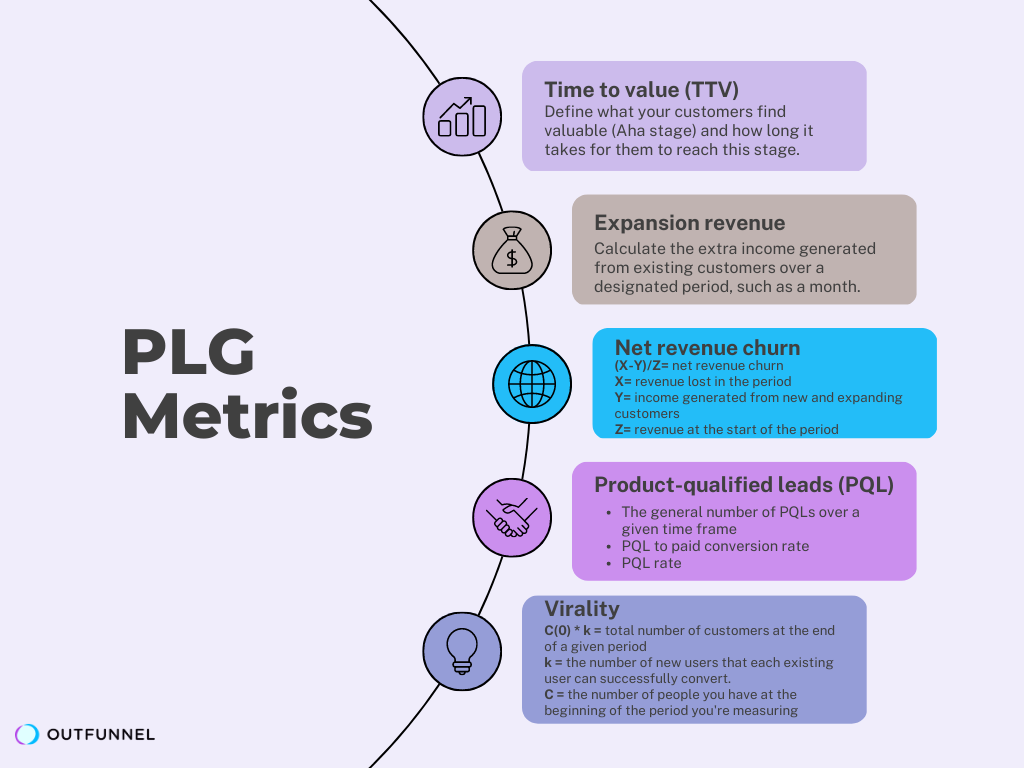
Key PLG Metrics You Must Track in 2026
- Activation Rate: % of sign-ups reaching the Aha! moment
- Time-to-Value (TTV): Hours/days to first success
- Free-to-Paid Conversion
- Product-Qualified Leads (PQL) Rate
- Net Revenue Retention (NRR) — Target: 120%+
- Viral Coefficient (k) — >1.0 = explosive growth
- Expansion Revenue %
- Retention & Churn (especially Day 1, Day 7, Day 30)
Real-World Product-Led Growth Success Stories (2025–2026)
- Slack — Team invites + message limits = legendary virality.
- Notion — Free plan + beautiful templates + real-time collab → teams expand organically.
- Canva — Drag-and-drop magic + sharing → 260M+ monthly users and $3.5B+ ARR.
- Figma — Real-time multiplayer editing → designers evangelize internally.
- Calendly — One-click links create instant virality.
- Attio (2026 rising star) — AI-native CRM with 4x ARR growth through PLG motions.
- Cursor — Hit $200M ARR with zero sales reps initially (now adding hybrid elements).
Common Challenges & How to Overcome Them
- High early churn → Fix with faster TTV and better onboarding.
- Sales team resistance → Move to Hybrid PLG + Sales (self-serve for SMB, sales for enterprise).
- Scaling support → Use in-product AI help + community.
- Pure PLG ceiling → Most 2026 winners run Product-Led Sales (PLG for acquisition, targeted sales for expansion).
How to Implement PLG in Your SaaS (Step-by-Step)
- Define your North Star Metric (e.g., “weekly active teams of 3+”).
- Map the user journey and remove every friction point.
- Build self-serve onboarding (checklists + AI guidance).
- Choose pricing model and test 3 variants.
- Instrument analytics everywhere.
- Align teams — Product owns activation/retention, Marketing fuels discovery, Sales handles only high-value PQLs.
- Launch, measure, iterate weekly.
Start small: Pick one activation milestone and obsess over it for 90 days.
Final Takeaway for 2026
Product-Led Growth is no longer optional — it’s the new baseline for competitive SaaS.
The winners won’t just have great products. They’ll have products that sell themselves, guided by AI, priced by usage, and fueled by delighted users who become natural advocates.
Whether you’re a bootstrapped founder or scaling to $100M ARR, adopting PLG principles will dramatically lower your CAC, shorten sales cycles, and create defensible, compounding growth.
Ready to make your product the hero of your growth story?
Start today: Audit your onboarding flow this week and ask — “How fast can a new user feel the magic?”
How Skyno Digital Can Help You Build a PLG-Powered SaaS
At Skyno Digital (Mohali, Punjab), we don’t just design websites — we engineer complete PLG-ready SaaS products from scratch.
Our specialized services include:
- End-to-end SaaS development (subscription billing, user dashboards, admin portals)
- AI agents & smart onboarding flows
- Beautiful, conversion-focused UI/UX design
- Secure cloud hosting & scalable architecture
- Integrated digital marketing to fuel initial discovery
- CRM and analytics setup for PQL tracking
We’ve helped multiple businesses in India and globally launch successful SaaS products that grow through the product itself.
Contact us for free SaaS strategy consultation today and let’s turn your idea into a product-led growth machine.


